
Transfer Process

Many community college students transfer to four-year institutions. Be prepared to make a swift and easy transfer with these articles. Determine the most transfer-friendly universities, learn why some 4-year schools are limiting transfer students, and get tips on ensuring your credits go with you.

View the most popular articles in Transfer Process:

Avoid Losing Community College Credits When Transferring

Updated
|
Avoid Losing Community College Credits When Transferring
Learn how to avoid losing community college credits when transferring to a university, including articulation agreements, transfer tools, and 2026 best practices.

For millions of students each year, community college serves as a practical and affordable starting point on the path to a bachelor's degree. According to the National Center for Education Statistics, more than one third of undergraduate students attend community colleges in the United States.

However, many students encounter an unexpected obstacle when they transfer: not all of their credits transfer with them.

Losing community college credits when transferring to a university can delay graduation, increase tuition costs, and create frustration for students who thought they were on track. Fortunately, careful planning and informed decision-making can dramatically reduce the risk.

This guide explains why transfer credits are sometimes lost and outlines practical strategies students can use in 2026 to ensure their community college coursework counts toward a four-year degree.

Why Community College Credits Don’t Always Transfer

Although transfer pathways have improved significantly in recent years, credit loss remains a common issue. Research from the U.S. Government Accountability Office shows that students who transfer lose an average of 43 percent of their credits during the process.

Several factors contribute to this problem.

Institutional Differences

Each college or university sets its own policies regarding transfer credits. Even when a course appears similar, universities may determine that it does not meet their curriculum requirements.

For example, a community college statistics course may not satisfy a university’s quantitative requirement if the syllabus differs significantly.

Lack of Articulation Agreements

Some community
. . .read more

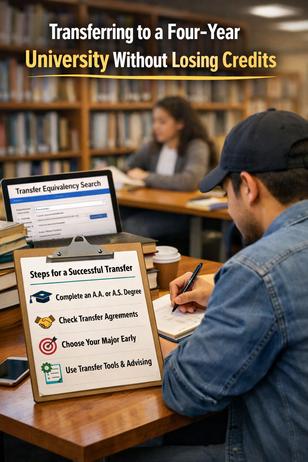
How to Transfer to a Four-Year University Without Losing Credits

Updated
|
How to Transfer to a Four-Year University Without Losing Credits
Learn how to transfer to a four-year university without losing credits in 2026, including agreements, planning tips, and expert guidance.

How to Transfer to a Four-Year University Without Losing Credits in 2026

Knowing how to transfer to a four-year university without losing credits is one of the most important concerns for today’s college students and families. In 2026, more than one third of bachelor’s degree recipients will have attended at least two institutions. Credit loss during transfer remains common, costly, and frustrating.

Understanding how to transfer to a four-year university without losing credits can save students thousands of dollars and months, sometimes years, of additional coursework. This guide explains how to transfer to a four-year university without losing credits using current policies, updated tools, and proven strategies that work in today’s higher education landscape.

Why Credit Loss Happens During College Transfers

Before learning how to transfer to a four-year university without losing credits, it helps to understand why credits are often lost. Colleges retain authority over which courses count toward their degree programs. Even accredited courses may be accepted only as electives or not at all.

Common reasons credit loss occurs include:

  • Course content that does not match major requirements

  • Credits earned at nationally accredited rather than regionally accredited institutions

  • Lack of articulation agreements between institutions

  • Changing majors after transfer

  • Outdated or incomplete advising

Understanding these risks is essential when planning how to transfer to

. . .read more

How to Transfer from Community College to a Four-Year University in 2025

Updated
|
How to Transfer from Community College to a Four-Year University in 2025
A step-by-step guide for community college students transferring to a four-year university in 2025 — updated strategies, data and expert insights.

How to Transfer from Community College to a Four-Year University in 2025

Transferring from a community college to a four-year university remains a viable and cost-effective pathway for many students. With rising tuition at four-year institutions and increasing mobility among undergraduate students, an informed transfer strategy in 2025 can open doors for achievement and degree completion. This article walks through key phases of the transfer process, updates on policy and data, expert insights and practical tips for students, parents and educators.

1. Why the Transfer Path Matters

Beginning at a community college can make financial sense. In the 2024–25 academic year, in-district tuition and fees at public two-year institutions averaged about US $3,598 annually. By comparison, in-state tuition and fees at public four-year institutions averaged around US $11,610 per year.

Beyond cost savings, the transfer route facilitates a “two-plus-two” model: two years of general education or foundational courses at a community college, followed by two years (or more) at a four-year university. Many states and institutions maintain articulation agreements or transfer-pathway programs for this purpose.

However, the statistics tell a cautionary tale. Research from the Community College Research Center (CCRC) finds that only about one-third of community college students transfer to a four-year institution, and fewer than half of those complete a bachelor’s degree within six years. A 2024 study found that among students who began at a community college in fall 2017,

. . .read more

What is an Articulation Agreement and Why Should You Care?

Updated
|
What is an Articulation Agreement and Why Should You Care?
Many students enter community college with the intent of transferring to a four-year college or university. Unfortunately, the path can be fraught with challenges. Articulation agreements between schools help students navigate the pitfalls to ensure an easier, more successful transition.

What is an Articulation Agreement and Why Should You Care?

If you were to ask any admissions counselor or community college administrator what an articulation agreement is, they wouldn’t hesitate to tell you.

  • However, if you ask any student on a community college campus, you might not get the same response.
  • Articulation agreements exist between many colleges, yet the majority of community college students have no idea what they are.

An articulation agreement is designed to create a seamless transfer experience for students moving from community college to four-year institutions.

  • Not every community college has them, but most do, and they are an invaluable resource for transfer students.
  • Read on to learn more about an articulation agreement and how it can benefit you as a community college student.

This video explains articulation agreements.

The Trouble with Transferring

According to the Community College Research Center, roughly 40% of undergraduates in the United States start their higher education at community colleges.

  • Of those, 80% intend to earn at least a bachelor’s degree, and about 20% end up transferring to a four-year college or university.
  • In the eyes of an incoming community college student, the future is bright, and community college is a stepping stone on the path to a four-year school.
  • Unfortunately, that path is not as easy to navigate as one would hope.
  • Between the challenges of completing prerequisites and
. . .read more

Why Don’t More Community College Students Transfer to Four-Year Schools?

Updated
|
Why Don’t More Community College Students Transfer to Four-Year Schools?
Explore the reasons behind low transfer rates from community colleges to four-year institutions, including financial obstacles, academic challenges, and systemic barriers. Learn about the success of those who do transfer and get tips for improving your chances of a successful transition.

Nearly six million students are enrolled in community college each year, many with the intent of eventually transferring to a traditional four-year university. That transfer is not without challenges, however, as many schools don’t accept all community college credits, and transfer acceptance rates remain relatively low. Those who do make the transfer tend to succeed. So, why do colleges and universities overlook community college students, and why do more students not transfer?

In this article, we’ll look at the statistics for how many community college students move on to four-year colleges and universities. We’ll also explore the data on how well they perform and provide some tips for community college students considering transferring.

How Many Community College Students Transfer?

As college tuition costs continue to rise and more families struggle to make ends meet, the number of students who choose to start their college education at community college continues to grow. Community college appeals to many because the tuition is typically more affordable, and other costs can be kept low by living at home versus on campus. Community colleges also offer flexible scheduling for non-traditional students, including single parents and adults returning to school.

According to an article published by the National Student Clearinghouse, about 80% of entering community college students want to earn a bachelor’s degree or higher, making them likely to transfer to a four-year college at some point. However, only 29% of community college students who started classes in the

. . .read more

Recent Articles

Test Article, Image and Content
Test Test Test Test Test Test Test Test Test Test Test Test Test Test Test Test Test Test Test Test Test Test Test Test Test Test Test Test Test Test Test Test Test Test Test Test Test Test Test Test Test Test Test Test Test Test Test Test Test Test Test Test Test Test Test Test Test Test Test Test Test Test Test Test Test Test Test Test Test Test Test Test Test Test Test Test Test Test Test Test Test Test Test Test Test Test Test Test Test Test Test Test Test Test Test Test Test Test Test Test Test Test Test Test Test Test Test Test Test Test Test Test Test Test Test Test Test Test Test Test Test Test Test Test Test Test Test Test Test Test Test Test Test Test Test Test Test Test Test Test Test Test Test Test Test Test Test Test Test Test Test Test Test Test Test Test Test Test Test Test Test Test Test Test Test Test Test Test Test Test Test Test Test Test Test Test Test Test Test Test Test Test Test Test
Faith Formation Integrated Across Subject Areas
Explore faith formation integrated across subject areas and its impact on curriculum, student outcomes, and community colleges.
Parish-Based Governance Models in Catholic Schools
Explore parish-based governance models in Catholic schools and their impact on leadership, funding, and community colleges.