When the economy collapsed in 2008, car manufacturers were one of the biggest industries to feel the pinch. Four years later, the industry is slowly but surely rebounding, but without a skilled workforce, it needs to rebuild properly. According to many recent reports, the solution to the worker shortage appears to be community colleges; more specifically, in community colleges across the country that are partnering with major auto manufacturers to make sure the skilled workers are ready and able to take the jobs that are currently open and waiting for them.
Major Companies Partner with Schools
Higher education occasionally makes strange bedfellows, with the latest auto manufacturing collaboration coming from some unlikely allies. The Huffington Post reports that Ford, GM, and Toyota are teaming up with other manufacturers to create a training curriculum that will meet the needs of the entire industry. The curriculum will specifically be geared toward community colleges, particularly those in Michigan – the auto manufacturing capital of the country that could use an economic boost since the recent recession.
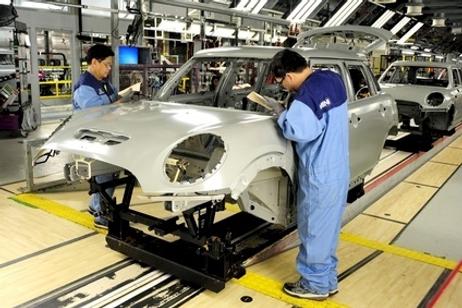
These new auto training programs will be broad enough to encompass the various manufacturers' products, while specific enough to bring students right from the classroom to the assembly line. Studies will focus on helping students compete globally, using skills that will easily translate from one manufacturer to another. The joint effort between the automakers ensures that every piece of the curriculum will be relevant to the entire auto industry in the United States.
“I think it is unusual,” Dennis Parker, an assistant manager for Toyota’s North American Production Support Center in Georgetown, Kentucky, told the Huffington Post. “It represents a new level of U.S. manufacturing working together in areas where it has meaning to work together, to give us a stronger manufacturing stance as the rest of the world becomes more competitive with us.”
The Automotive Manufacturing Technical Education Collaborative
The efforts are a part of the Automotive Manufacturing Technical Education Collaborative, founded by Toyota and the Kentucky Community and Technical College System in 2005. The location was chosen at the time because Kentucky is home to Toyota’s largest manufacturing plant in the U.S. However, since then, the collaborative has added GM and Ford to the partnership, broadening the need for qualified training in other areas of the country.
Although the collaboration began somewhat slowly, the addition of partners and a grant from the National Science Foundation helped fuel the fire. This year, the new curriculum that includes mechanical, computer, control, electrical, and software engineering will make its debut at Henry Ford Community College in Dearborn, Michigan.
This video describes The Automotive Technology Program at Macomb Community College South Campus in Warren provides students with the skills, knowledge, and abilities required to obtain employment in the automotive repair career field.
“In southeast Michigan, where we’ve really been hit hard by the economy, we’ve really been growing…trying to stay abreast,” Gail Mee, president of Henry Ford Community College, told the Huffington Post. Mee describes recent changes in the auto industry as a “remarkable kind of cultural transformation inside the manufacturing workplace.”
More Maintenance Training Needed
Manufacturing isn’t the only area where the auto industry relies on community colleges to provide additional skilled workers. As auto technology becomes more complex, training is needed at higher levels to prepare technicians for the job of maintaining and repairing vehicles already on the road. To that end, Toyota recently met with around 100 community college instructors nationwide to discuss how to train the next generation of auto technicians, according to a report in the Farmington Daily Times.
The recent meeting is a part of Toyota’s Technical Education Network, better known as T-Ten. The automaker designed this collaboration to ensure training at community colleges is on par with the auto industry's needs. T-Ten meets every six months for the purpose of professional development. The location is rotated to ensure everyone in the network can attend a meeting nearby. The meetings address the changing needs of auto technicians as the industry becomes more technologically-based.
This video describes The St. Louis Community College Automotive Technology program, which prepares students for entry-level positions in the automotive industry at beginning supervisory and managerial levels.
“We want everybody to be doing training at the highest level possible,” Rick Lester, technician development manager for Toyota Motor Sales USA, Inc., told the Daily Times.
Improving Completion Rates through Automotive Training
Another community college is also using its automotive training to improve completion rates. The Indianapolis Business Journal reports that Ivy Tech Community College has invested $500,000 to revamp its automotive program, updating the curriculum and accelerating the program to allow students to earn certification in just one year rather than two. The program will keep students in classes six to eight hours daily, five days a week. The shorter training program is designed specifically to improve completion rates among students who have enrolled in the automotive training program.
“I think this is the way of the future,” Steve Daily, Ivy Tech Kokomo Regional Chancellor, told the Indianapolis Business Journal.
Manufacturing Training Finding New Life
Other schools are revving up manufacturing programs, spurred in part by the rising needs of the automotive industry. Last year, a new manufacturing training program was launched at Oakland Community College in Michigan. The program will address the needs of the nearby manufacturing industry, which includes nearly 200 German-owned companies.
“The automotive industry is driving this new trend with the IT boom in the automobile, but we are seeing this ‘technical merging’ in other manufacturing industries as well,” Irene Spanos, director of economic development and community affairs for Oakland County told Plant Engineering. “We are working with the employers in our region – some of the largest technology companies in the world – to ensure the workforce they need globally is qualified and trained here in Southeast Michigan.”
This video from Nashua Community College describes the Associate of Science degree in Honda Automotive Technology, a partnership with the Professional Automotive Career Training (PACT) program of American Honda.
The revival of manufacturing and subsequent training is great news for prospective community college students.
Questions? Contact us on Facebook. @communitycollegereview