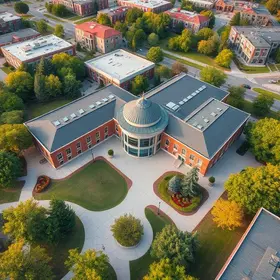
School Highlights
Miller-Motte College-Fayetteville serves 390 students (98% of students are full-time).
Minority enrollment is 85% of the student body (majority Black), which is more than the state average of 48%.
Quick Facts (2026)
- Enrollment: 390 students
- Acceptance Rate: 75%
- Minority enrollment: 85%
- Source: Integrated Postsecondary Education Data System (IPEDS)
Top Rankings
Miller-Motte College-Fayetteville ranks among the top 20% of public schools in North Carolina for:
Category
Attribute
School Overview
Miller-Motte College-Fayetteville
(NC) Community College Avg.
Carnegie Classification
Special Focus Two-Year: Health Professions
Associate's Colleges: Mixed Transfer/Career & Technical-High Nontraditional
Institution Level
At least 2 but less than 4 years
At least 2 but less than 4 years
Institution Control
Private for-profit
Public
Total Faculty
n/a
256 staff
Number of Programs Offered
7
68
Student Body
The student population of Miller-Motte College-Fayetteville has declined by 20% over five years.
The Miller-Motte College-Fayetteville diversity score of 0.58 is less than the state average of 0.66. The school's diversity has stayed relatively flat over five years.
Total Enrollment
390 students
2,579 students
Student-Teacher Ratio
n/a
13:1
# Full-Time Students
383 students
766 students
# Part-Time Students
7 students
1,813 students
# Enrollment Undergraduate
390 students
316 students
# Full-Time Undergraduate Students
383 students
766 students
# Full-Time Graduate Students
n/a
22 students
# Part-Time Undergraduate Students
7 students
1,990 students
# Part-Time Graduate Students
n/a
3 students
Total Dormitory Capacity
n/a
717 students
% American Indian/Alaskan
5%
1%
% Asian
1%
3%
% Hispanic
7%
13%
% Black
62%
21%
% White
15%
52%
% Hawaiian
1%
1%
% Two or more races
8%
3%
% Non Resident races
n/a
1%
% Unknown races
2%
5%
Diversity Score
0.58
0.66
College Completion Rate (Students who graduate in less than 4 years)
0.3927%
37%
College Completion Rate (Students who graduate in 4 years or more than 4 years)
n/a
43%
Average Graduate Earnings (10 Years)
$20,400
$27,200
Tuition and Acceptance Rate
% Students Receiving Some Financial Aid
56%
82%
Median Debt for Graduates
$23,668
$10,994
Median Debt for Dropouts
$9,168
$5,700
Acceptance Rate
75%
82%
SAT Reading
n/a
488
SAT Math
n/a
498
ACT Composite
n/a
20
ACT English
n/a
13
ACT Math
n/a
16
Source: 2024 (or latest year available) Integrated Postsecondary Education Data System (IPEDS)
Frequently Asked Questions
What is the acceptance rate of Miller-Motte College-Fayetteville?
The acceptance rate of Miller-Motte College-Fayetteville is 75%, which is lower than the state average of 82%.
What is Miller-Motte College-Fayetteville's ranking?
Miller-Motte College-Fayetteville ranks among the top 20% of community college in North Carolina for: Average community college minority breakdown.
Nearby Schools
The nearest community college to Miller-Motte College-Fayetteville is Fayetteville Technical Community College (4.0 miles away)
School
Location
Miles
Quick Facts
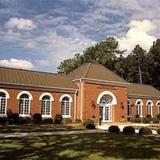
2201 Hull Rd
Fayetteville, NC 28303
(910) 678-8400
Fayetteville, NC 28303
(910) 678-8400
4.0 miles
Enrollment: 15,510 students Student-teacher ratio: 33:1 Acceptance rate: 100% In-state tuition: $2,628 Out-state tuition: $8,772 Minority enrollment: 67%
1105 Kelly Dr
Sanford, NC 27330
(919) 775-5401
Sanford, NC 27330
(919) 775-5401
29.0 miles
Enrollment: 6,905 students Student-teacher ratio: 11:1 Acceptance rate: 25% In-state tuition: $2,396 Out-state tuition: $8,540 Minority enrollment: 50%
Sandhills Community College
Public
3395 Airport Rd
Pinehurst, NC 28374
(910) 692-6185
Pinehurst, NC 28374
(910) 692-6185
30.6 miles
Enrollment: 4,786 students Student-teacher ratio: 11:1 In-state tuition: $2,385 Out-state tuition: $8,529 Minority enrollment: 47%
Robeson Community College
Public
5160 Fayetteville Road
Lumberton, NC 28360
(910) 272-3700
Lumberton, NC 28360
(910) 272-3700
30.8 miles
Enrollment: 2,626 students Student-teacher ratio: 11:1 In-state tuition: $2,386 Out-state tuition: $8,530 Minority enrollment: 80%
Bladen Community College
Public
7418 NC Hwy 41 West
Dublin, NC 28332
(910) 879-5500
Dublin, NC 28332
(910) 879-5500
32.8 miles
Enrollment: 1,459 student Student-teacher ratio: 11:1 In-state tuition: $2,385 Out-state tuition: $8,529 Minority enrollment: 58%
Recent Articles

Test Article, Image and Content
Test Test Test Test Test Test Test Test Test Test Test Test Test Test Test Test Test Test Test Test Test Test Test Test Test Test Test Test Test Test Test Test Test Test Test Test Test Test Test Test Test Test Test Test Test Test Test Test Test Test Test Test Test Test Test Test Test Test Test Test Test Test Test Test Test Test Test Test Test Test Test Test Test Test Test Test Test Test Test Test Test Test Test Test Test Test Test Test Test Test Test Test Test Test Test Test Test Test Test Test Test Test Test Test Test Test Test Test Test Test Test Test Test Test Test Test Test Test Test Test Test Test Test Test Test Test Test Test Test Test Test Test Test Test Test Test Test Test Test Test Test Test Test Test Test Test Test Test Test Test Test Test Test Test Test Test Test Test Test Test Test Test Test Test Test Test Test Test Test Test Test Test Test Test Test Test Test Test Test Test Test Test Test Test

Faith Formation Integrated Across Subject Areas
Explore faith formation integrated across subject areas and its impact on curriculum, student outcomes, and community colleges.

Parish-Based Governance Models in Catholic Schools
Explore parish-based governance models in Catholic schools and their impact on leadership, funding, and community colleges.